


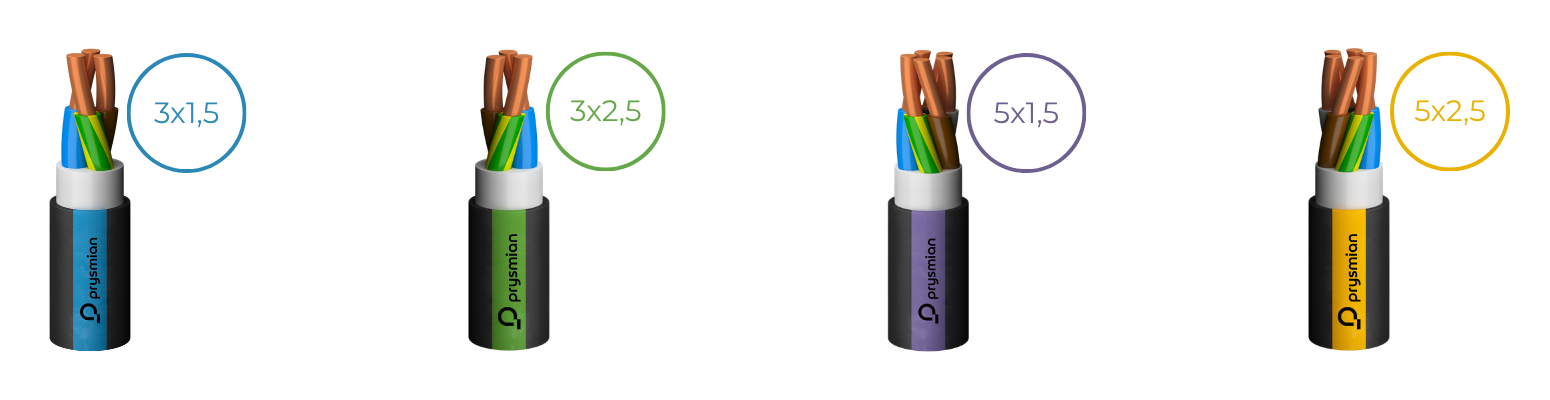
- Instant visual identification – The coloured stripe enables quick recognition of the cable type and cross-section, reducing the risk of errors during installation and maintenance work.
- Faster installation process – Installers can sort cables more efficiently and route them more easily without having to read small markings or repeatedly check printed labels.
- More efficient warehouse management – Warehouses and distributors can distinguish between cable variants at a glance, speeding up order picking, packing, and inventory control.
- More durable marking – The stripe is integrated into the cable's outer sheath, ensuring it remains clearly visible for years, even in demanding environments where printed markings may gradually fade.
CYKYprofi Cables
From the first sight
CYKYprofi is the well-known CYKY installation cable, reimagined. It retains all the features that electricians and installers have trusted for years, while its colour-coded identification system allows for instant cable recognition at first glance.
Profi Tips
What is the green-yellow core used for?
Toggle DetailsUnder normal operating conditions, no current flows through the protective conductor. Its purpose is to safely carry fault current in the event of insulation damage or equipment failure, allowing electrical protection devices to operate quickly and effectively.
As a result, the protective conductor reduces the risk of electric shock and enhances the safety of both users and electrical equipment. It is a fundamental element of effective electrical shock protection in modern installations.
Profi Tip:
If grounding is required in the installation, choose a cable marked with G. This designation indicates the presence of a green-yellow protective conductor. If a protective conductor is not required, choose a cable marked with the letter O, which does not contain a green-yellow protective conductor.
CYKY or 1-CYKY?
Toggle DetailsCYKY is an installation cable designed for fixed electrical installations inside buildings. It is most commonly installed under plaster, embedded in plaster, or routed through protective installation conduits.
1-CYKY is a power cable with a reinforced construction, designed for use in more demanding environmental conditions. It can be installed outdoors and laid directly in the ground.
Profi Tip:
Choose CYKY for indoor installations and 1-CYKY wherever the cable will be exposed to moisture, UV radiation, or installed underground.
Common mistake
Toggle DetailsYou have a new kitchen, you're connecting an oven or an induction cooktop, and suddenly a problem appears. Choosing a cable with a cross-section that is too small can cause excessive conductor heating, frequent circuit-breaker tripping, and, in extreme cases, damage to the electrical installation.
Selecting the wrong cable cross-section is one of the most common mistakes made during electrical installations. A cable may fit the terminals, but that does not necessarily mean it is suitable for the required load.
Profi Tip:
Choose the cable cross-section based on the electrical load, not just the connection method.